


Arizona Critters
This page contains information about species currently, or once commonly found in Arizona. Many animals make Arizona their home. Some species are endangered or threatened by loss of habitat. Some have already vanished from the state.

Black Swallowtail / Papilio polyxenes
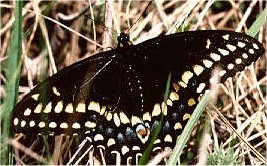
Description: 2 5/8-3 1/2 in. (67-89 mm). Black to blue-black above with blue cloud on outer HW (more blue on female). Small cream-yellow spots and chevrons rim wings above and below (larger on male). Bright orange eyespot with round, black-centered pupil at corner of HW toward body. Sometimes band of yellow spots across outer third of wings inside row of blue patches, more commonly present or enlarged on male. No yellow stripes on thorax.
Habitat: Open spaces including gardens, farmland, meadows, and banks of watercourses; seldom in woodlands.
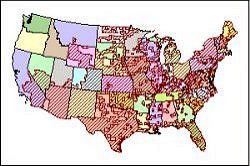
Range: S. Canada along E. Rockies into Arizona and Mexico, and east to Atlantic. The range map shown here is based on confirmed sightings by U.S. county. It may not represent the entire range of the species, since some counties may not have reported it. This is especially true where there are small negative areas inside a large positive area.
Comments: Eastern Black Swallowtails may be attracted to gardens by parsley or carrot plants, and nectar sources such as phlox and milkweed. Less blue and less rapid than the Pipevine Swallowtail, the Eastern Black likes to flit among the vegetation, drifting and stalling again and again, until disturbed; then it takes off in a direct line, making it most difficult to pursue. A similar-looking species of the Missouri Ozarks, known as the Ozark Swallowtail (Papilio joanae) has dramatically different habits. It dwells in forests, where caterpillars feed on meadow parsnip (Heracleum). Another related black swallowtail, the Kahli Swallowtail (Papilio kahli), flies in Manitoba and Saskatchewan and may be a hybrid of the Old World Swallowtail. It frequents bare hilltops, where females lay their eggs on cow parsnip (Heracleum lanatum).
Geo-Archaeological Information Applications Lab
School of Human Evolution & Social Change
Arizona State University, Box 872402
Tempe, AZ 85287-2402
Webmaster - shsavage@asu.edu